GSA SER Verified Lists
What Are GSA SER Verified Lists?
GSA SER verified lists are pre-screened collections of target URLs that have already been tested and confirmed to work with GSA Search Engine Ranker. Instead of scraping and verifying targets from scratch, you load a list where every entry has passed prior checks for submission forms, captcha types, and platform compatibility. These lists save massive amounts of time because the heavy lifting of filtering dead sites, removing duplicates, and confirming that an engine can actually post a link has already been done.
Why Verification Matters More Than Volume
A colossal list full of unverified domains is worse than a small, clean one. Unverified targets lead to high failure rates, wasted proxies, and unnecessary captcha costs. When you use GSA SER verified lists, you feed the tool links that stand a genuine chance of sticking. This dramatically improves the LPM (links per minute) efficiency and reduces the strain on your hardware and IP resources. The verification process checks for login pages, error pages, redirects, and even whether the platform allows contextual or profile links, giving you a realistic picture of the actual success rate you can expect.
The Hidden Cost of Skipping Verification
Skipping verified lists means your project spends hours hammering domains that are no longer active, have changed their CMS, or deploy JavaScript traps that SER cannot parse. Each failed attempt still consumes a thread, a proxy hit, and often a captcha solve. Over the course of a month, those micro-costs accumulate into significant financial waste. Verified lists eliminate that bleed by ensuring that 80-90% of the targets you attempt are live, compatible, and ready to accept submissions.
How GSA SER Verified Lists Are Built
High-quality lists are not simply scraped once and sold. They are constructed through layered screening. First, native GSA SER engines or custom footprints extract a massive pool of potential URLs based on platform footprints like “powered by WordPress†or specific forum software. Then, the raw list goes through a verification pass using a dedicated project inside GSA SER set to ultra-conservative settings. This pass confirms that the site is online, the platform is correctly identified, and the submission form is functional. Finally, manual spot-checks and de-duplication against common spam lists remove honeypots and dangerous neighborhoods.
Platform-Specific Verified Segments
The most useful verified lists are broken down by platform type. You might have separate lists for WordPress comments, Joomla K2, Drupal articles, wiki pages, and forum profiles. This granularity allows you to craft hyper-relevant link-building strategies. For example, a verified list dedicated to non-English social bookmarks can be priceless for a regional campaign, while a clean list of high-DA guestbook targets handled gently can provide indexing boosts without triggering filters.
Integrating Verified Lists Into Your Workflow
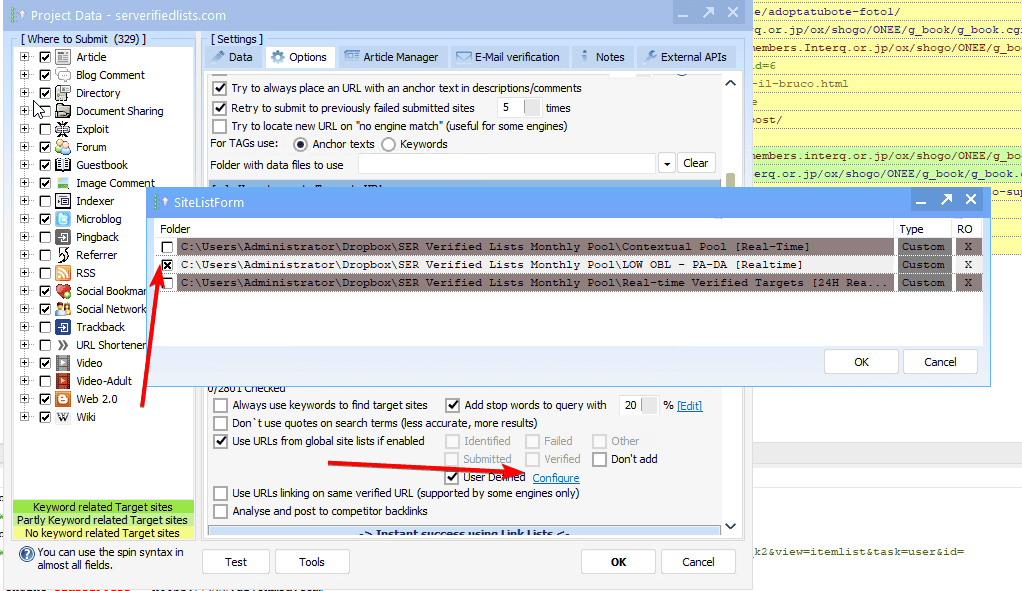
Loading a verified list into GSA SER is straightforward: you import the text file into the “Target URLs†field of a project and let the software match the URLs to the appropriate engines. The real art comes in how you treat those trusted targets. Because you know the sites accept submissions, you can afford to lower retry delays, allocate more threads, or pair the list with high-quality private proxies. You can also set the project to prioritize contextual engines over simple profile links, because the list already confirms which URLs belong to which category.
Maintaining Freshness and Avoiding Footprints
Even verified lists decay. Sites go offline, switch to HTTPS, or change their CMS. A smart SEO workflow involves running a re-verification every two to four weeks to prune dead entries and keep the list compact. Furthermore, repeatedly hitting the exact same sequence of verified URLs across multiple domains is a footprint. To mitigate this, always shuffle the imported list, use random submission delays, and blend in a percentage of newly scraped targets so your pattern never becomes entirely predictable.
Where to Obtain GSA SER Verified Lists Without Getting Burned
The marketplace is flooded with outdated dumps renamed as “verified.†Genuine GSA SER verified lists come from communities where users share test results and include metadata like the date of last verification, the number of active links, and the engine types covered. Look for sellers or forum threads that provide sample lines for you to test before purchasing. A trustworthy list often includes a log file from the verification run so you can audit the exact settings used. Avoid any product that promises millions of targets for a few dollars; a realistic, freshly verified list rarely exceeds 50,000 to 100,000 truly live, submission-ready URLs across all engines.
Building Your Own Verification Pipeline
Relying entirely on third-party lists creates dependency. Savvy users set up a dedicated GSA SER instance whose only job is to verify and build lists. They export URLs from successful campaigns, run them through a second, highly defensive verification project, and then store the confirmed targets in a rotating master file. Over time, you accumulate a proprietary collection of GSA SER verified lists that no one else has, and you can even peel off subsets to sell or trade within private mastermind groups.
The SEO Impact of Using Verified Targets
Ultimately, the link graph you construct depends on the quality of the nodes you touch. GSA SER verified lists do not guarantee tier-1 safety, but they prevent the worst-case scenario: sending easily detectable spam signals to honeypots that can flag your entire money site. They keep your tiered link-building contained to sites that have demonstrated a tolerance for user-generated content. This containment translates to more stable rankings, fewer manual action surprises, and a healthier backlink profile when viewed through the lens of modern search algorithms that still process link data in aggregate.
check here